
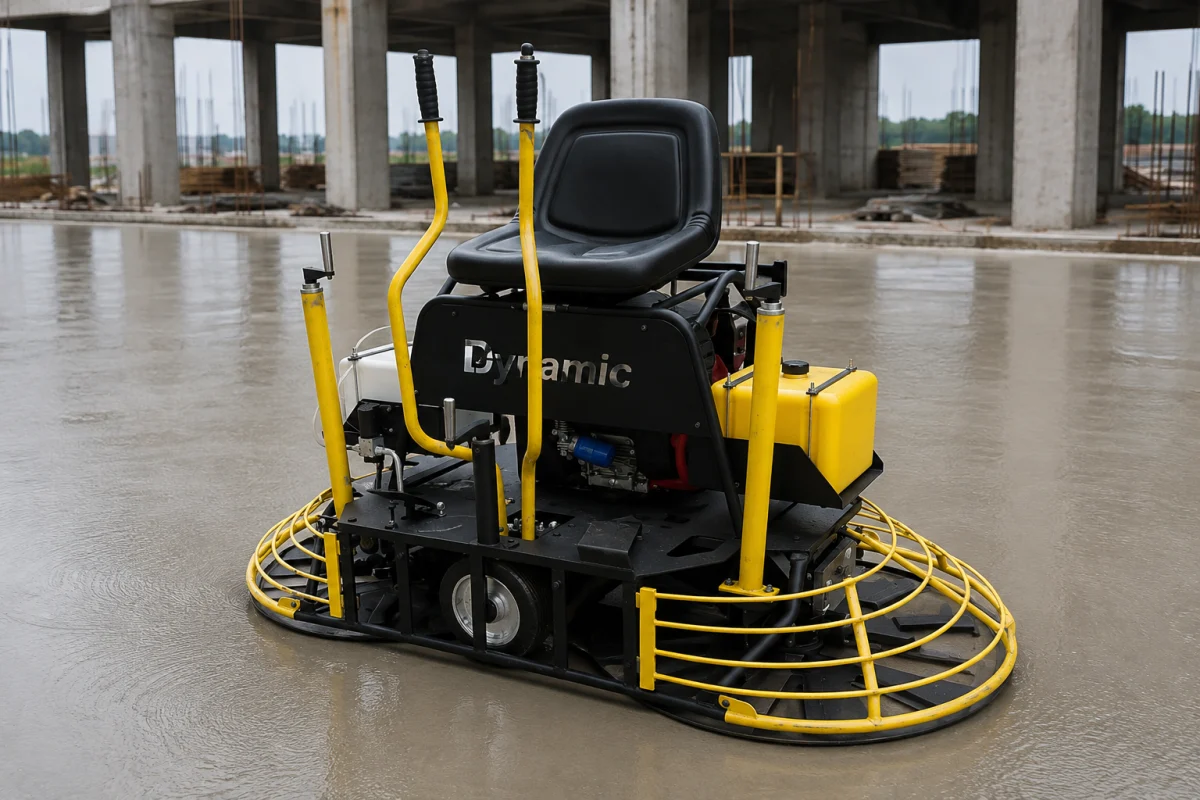
Use a ride-on power trowel when floor area is large enough that a walk-behind machine cannot finish within the concrete window. A twin-rotor ride-on machine with a 1,900 x 915 mm working diameter and 8 blades covers ground several times faster. Walk-behind trowels remain necessary for edges, corners and smaller pours.
The constraint is time, not area
Concrete gives you a window. Power floating and trowelling have to happen while the slab is in the right condition, and that window does not extend because your machine is small. A concrete power trowel machine — ride-on or walk-behind — exists to finish the pour inside that window with the finish the specification demands.
This is the whole argument for a ride-on trowel. It is not about comfort. It is about coverage inside the window.
Work out the area of your typical pour and the realistic window in your climate. If a walk-behind machine cannot cover that area in that time, no amount of operator effort will fix it.
Ride-on power trowel
A twin-rotor ride-on machine — ours is the QUM-80 ride-on power trowel — carries two rotors, typically 8 blades in total, with a working diameter around 1,900 x 915 mm. Rotor speed is adjustable, commonly in the 120 to 140 rpm range, and a 24 HP petrol engine is typical on this class.
Advantages on a large floor:
- Coverage per pass is several times a walk-behind machine
- Operator weight and machine weight give consistent blade pressure
- Consistent overlap, which shows in the finished surface
- Far less operator fatigue over a long finishing shift
Walk-behind power trowel
Single rotor, smaller diameter, operator walks behind. It is the right machine for:
- Smaller pours where a ride-on machine cannot justify itself
- Edges, perimeters and corners the ride-on cannot reach
- Confined areas, plant rooms and small bays
- Sites where the slab is not large enough to get a ride-on machine moving
Most warehouse and industrial floor operations run both. The ride-on machine does the field; the walk-behind does the perimeter.
Power trowel machine price in India
The ride-on class is the machine with a real price tag: the QUM-80 runs Rs 3,70,000 – Rs 4,07,000 ex-works Delhi, with freight and GST extra. Walk-behind machines cost a fraction of that, and we will say so rather than upsell — we stock the ride-on class, and if your pours are small enough that a walk-behind covers the window, we will tell you before quoting. The full range context is on our power trowel machines page.
Price the machine against the window, not against the catalogue: one blown finishing window on a specified floor costs more than the difference between the two classes.
Blades: float pans and finish blades
Trowelling is a sequence, not a single operation.
Float pans go on first, when the slab is still soft. They spread load, avoid digging in, and bring the surface up flat.
Combination and finish blades follow as the slab hardens, progressively steepening the blade angle to burnish the surface.
Running finish blades too early digs into the surface. Running float pans too late achieves nothing. This is where operator experience matters more than machine specification.
Where the trowel sits in the sequence
On a warehouse or industrial floor with a flatness specification, the trowel is the last machine, not the first. Before it:
- Concrete placed and spread
- Levelled, on a specified floor by a laser guided levelling machine
- Allowed to reach the correct condition
- Power floated with pans
- Power trowelled to the required finish
A trowel cannot fix a floor that was not levelled correctly. If flatness is specified, the levelling machine is the machine that decides whether you pass — the full equipment sequence is in our warehouse floor flatness guide.
What to check before buying
- Working diameter against your typical pour area and window
- Blade count and rotor configuration, and whether pans are included
- Engine, and whether it can be serviced locally
- Machine weight, and how it gets on and off the slab
- Who commissions it and trains the operator on the blade sequence
Send us your pour sizes and floor specification — you will get a same-day quotation, and an honest answer if the machine you asked about is more than the job needs.
Power trowel machine FAQs
What is the price of a power trowel machine in India?
A twin-rotor ride-on power trowel like the QUM-80 runs Rs 3,70,000 – Rs 4,07,000 ex-works Delhi. Walk-behind machines cost a fraction of that — the deciding factor is whether one can finish your pour inside the concrete window, not the price gap.
Ride-on or walk-behind — which do I need?
Measure your typical pour area against your finishing window. If a walk-behind cannot cover it in time, you need the ride-on; most floor operations end up running both — ride-on for the field, walk-behind for edges.
When do float pans come off and finish blades go on?
Pans work while the slab is still soft; blades follow as it hardens, steepening angle pass by pass. Too-early blades dig in, too-late pans do nothing — train the operator on the sequence, not just the machine.
Where can I buy a concrete power trowel machine?
Our QUM-80 is stocked in Delhi and supplied across India — see it running before you buy. Commissioning and operator training on the blade sequence are part of the supply, not an extra.
Frequently Asked Questions
What is the difference between a ride-on and walk-behind power trowel?
What is the price of a ride-on power trowel in India?
How large a floor needs a ride-on trowel?
What is a power float machine?
How many blades does a ride-on power trowel have?
Can a power trowel fix an uneven floor?
Machines Covered in This Guide
Get a price for your job
Tell us the material, the area and the specification you have to meet. We will come back with the right machine, the price and the delivery date — usually the same working day.